
August 6, 2026
3D Printing Portfolio: What to Show Clients So They Actually Order
Someone looking for a 3D printing shop almost never understands the technology — they can't tell FDM layer lines from resin, and they won't judge fit tolerances. They look at photos and decide whether to trust you with their part. A portfolio sells harder than any text on your site: one weak photo set kills conversions even if your prints are genuinely good.
What to photograph
- The finished part in context of use. A bracket mounted on a wall, not lying on a table. A miniature next to other figures on a game board, not alone on a white background. A case or part installed in the device it belongs to. Context shows what the thing is for, and makes it easier for a client to picture their own order in that same spot.
- Before/after for repairs and restoration. If you print replacement parts for old appliances, restore broken mounts, or fix household items — this is one of the highest-converting content formats a shop can have. People are searching for a solution to their specific problem, and a clear "before — after" photo answers "can they do it with mine too" faster than any description.
- Variety of materials and colors. Ten identical gray gears in a portfolio tell a client you only print gears. Show different materials (PLA, ABS, resin), different colors, and different types of objects — it works like an implicit list of capabilities, even without a "what we do" caption next to it.
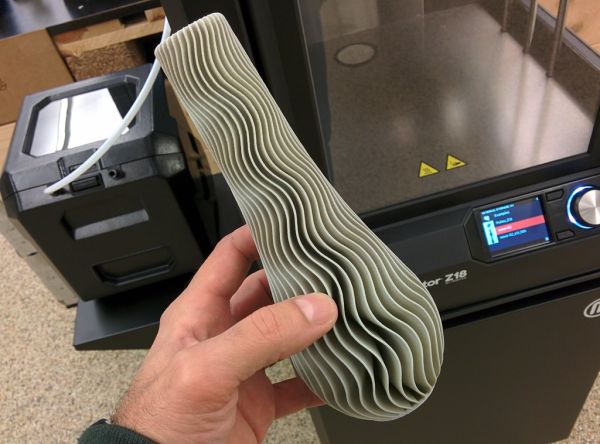
- Scale reference for small parts. A 3 cm miniature with nothing next to it looks like it could be anything from a keychain charm to a full statuette. Put a coin, a ruler, or a hand in the frame — it answers the most common question about small orders: "how small is this, actually."
What to avoid
- Defects in the photo. It sounds obvious, but makers regularly post the one flattering angle where you can't see delamination or an unfinished corner, just because "overall it's a good piece." A client who then receives something worse than the photo will leave a negative review — and that costs more than one missing item in your portfolio.
- Photos that are too small or too dark. People open portfolios on their phone, on the go — a 400×300 shot or one taken in dim workshop lighting gets lost on a small screen. Decent light and resolution do more for you than sheer photo count.
- No consistent style. You don't need to hire a photographer, but try to shoot in roughly the same lighting and against a similar background — a mix of "studio shot" and "phone snap under yellow light" looks sloppy even when print quality is identical.
Where to post it
Duplicating your portfolio across a few places is fine — each has a different audience:
- Your profile in the product's masters catalog — people who are already specifically looking for someone to print for them, not scrolling a feed at random.
- Social media — where most traffic from word of mouth and local communities lands; also a good place to post process shots, not just finished results.
- A dedicated page on your own site, if you have one — the longest-lived option, independent of any platform's algorithm.
How often to update it
Adding a couple of new pieces every 2-4 weeks is plenty for a small shop. Consistency matters more than volume: a portfolio last updated a year ago reads to a client as a sign the shop either isn't active or doesn't care how it looks from the outside. Remove old, weak photos too — a portfolio isn't an archive, it's a storefront, and weak examples dilute the strong ones.
Bottom line
A portfolio isn't optional decoration — it's part of your sales funnel: clients decide whether to message you or the next shop based on it. Show pieces in actual use rather than on a white background, be honest with before/after repair shots, add scale reference for small parts, and refresh the set at least once a month. That's enough to make a portfolio actually bring in orders instead of just existing.