
October 1, 2026
Bambu Lab R1: 55 W CO₂ Laser Cutter — What It Does, Price, and What It Means for a Workshop
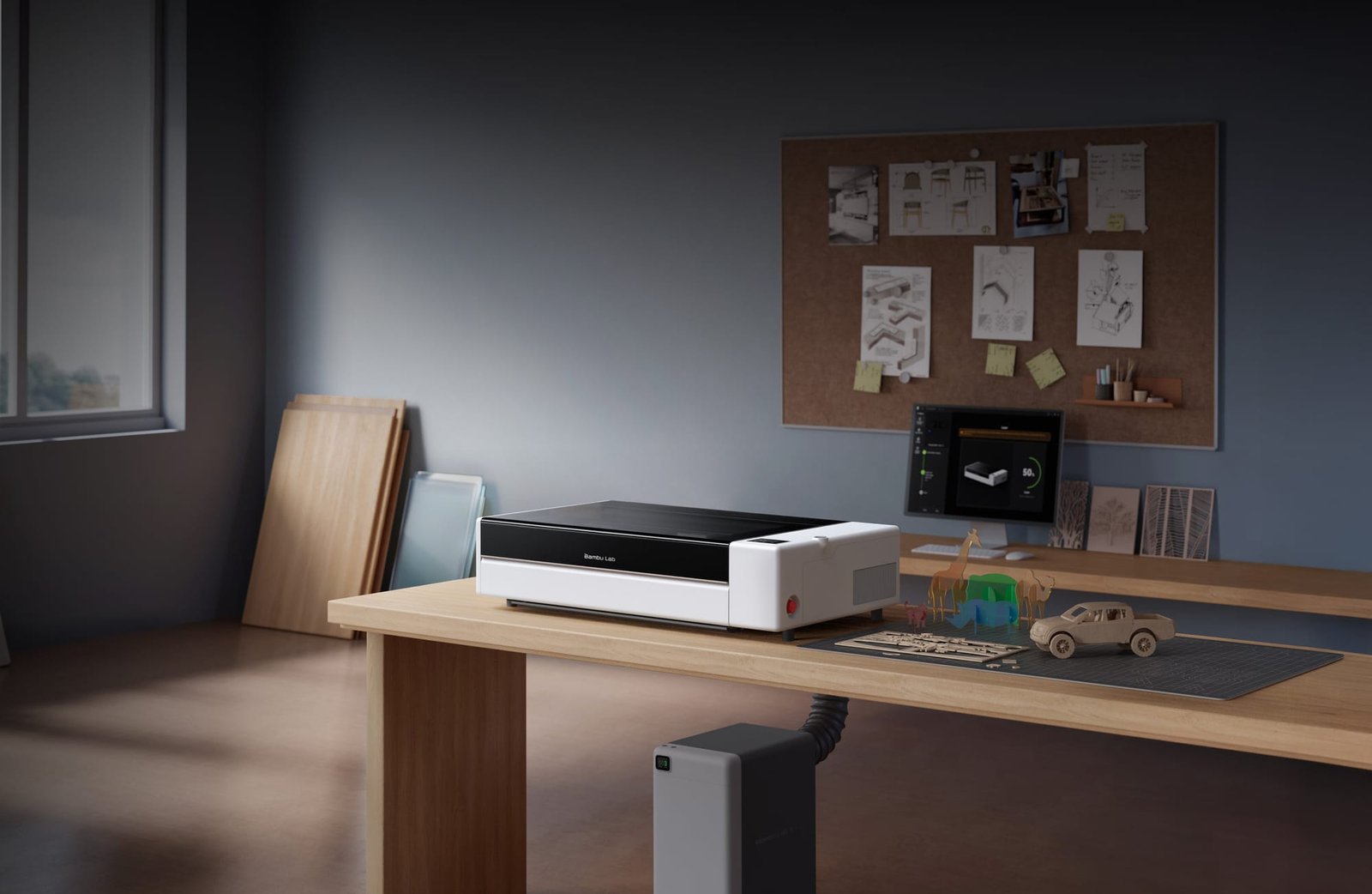
On September 22, 2026, Bambu Lab introduced the R1, a 55 W CO₂ laser for cutting and engraving. It is the first device in the company's history that is not a 3D printer, and the start of a separate product line. Until now, Bambu Lab's laser existed only as a module on the H Series printers; the R1 is a fully independent machine. For a workshop that already prints on Bambu Lab, it is a reason to think about a new service: cutting and engraving wood, acrylic, and leather.
What the R1 is and what's new
The R1 cuts and engraves wood, clear acrylic, leather, paper, and fabric, and engraves glass, stone, and coated metals. The key difference from a diode laser is that a CO₂ beam is absorbed by clear acrylic and glass (a diode beam passes straight through), so you can cut acrylic and engrave glass. A CO₂ laser also cuts thicker wood faster and with less edge charring.
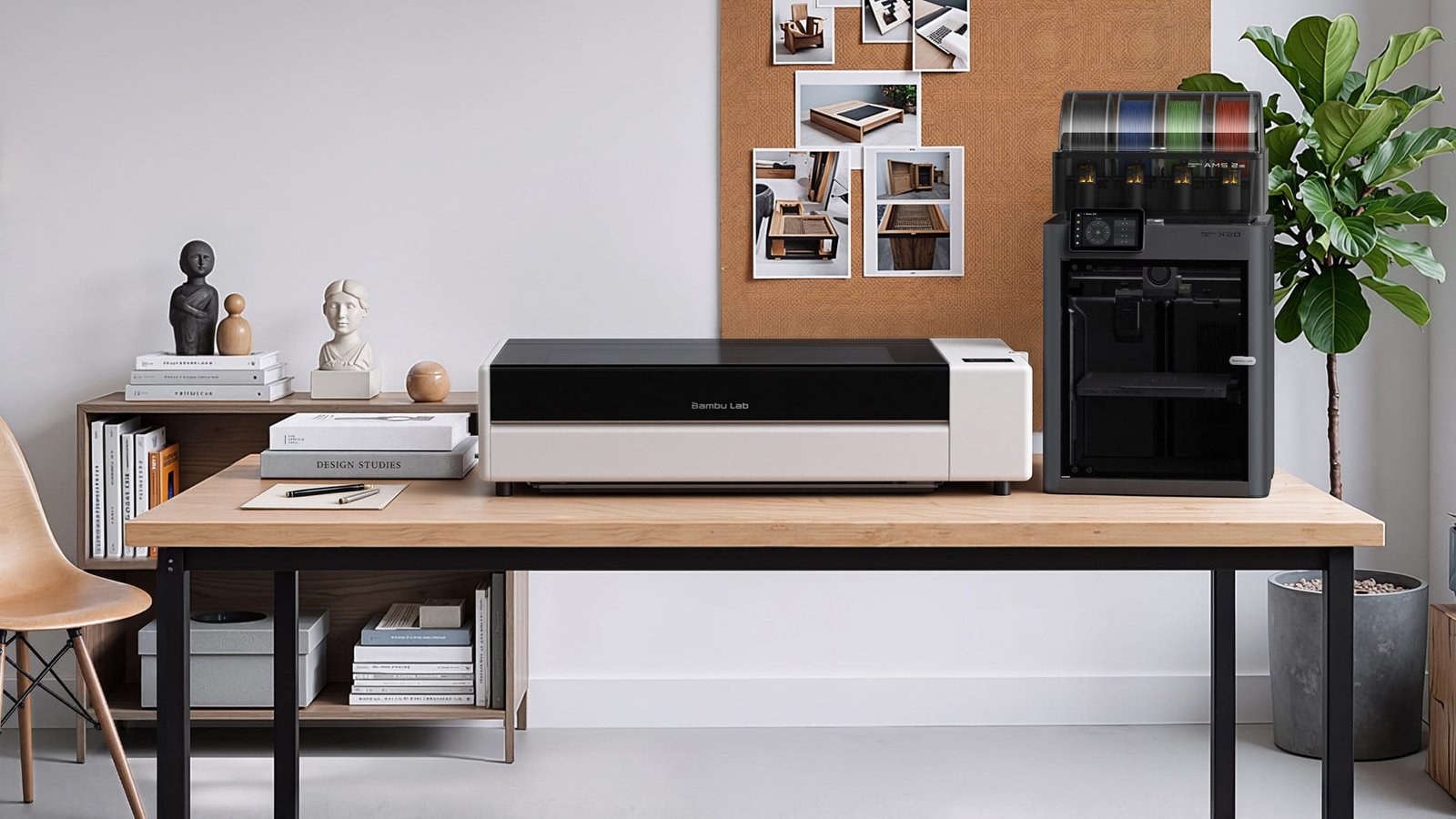
The manufacturer highlights:
- Auto Laser Alignment: a sensor on the toolhead reads the beam position and motorized actuators correct the mirrors, which takes about a minute instead of manual alignment with thermal paper.
- TriSense: cameras, a distance-measuring laser, and XY encoders let the machine find the material, measure surface height, and focus automatically, including on curved objects. According to Bambu Lab, alignment with printed graphics is within 0.2 mm (for example, contour-cutting around a sticker).
- Vibration Compensation and Speed-Synced Laser Power: the motion technology known from Bambu Lab 3D printers, retuned for a laser.
Specifications
| Bambu Lab R1 | |
|---|---|
| Source | 55 W CO₂ laser |
| Work area | 600 × 300 mm |
| Maximum speed | up to 1000 mm/s |
| Single-pass cutting | black walnut plywood up to 18 mm, acrylic up to 20 mm |
| Conveyor accessory | material up to 3,000 mm long |
| Software | Bambu Suite (Windows and macOS), same account and MakerWorld as the printers |
| Laser class | Class 1 per IEC 60825-1 in enclosed operation |
Price and availability
According to Bambu Lab, the R1 costs $2,499 in the US (before tax, shipping included) and €2,499 in the EU (tax included, shipping excluded). Pre-orders opened on September 22, 2026 in the official Bambu Lab store, with shipping starting in October. The package includes a short-focus lens; the Riser Base, Conveyor, Rotary attachment, medium- and long-focus lenses, Vision Encoder, E1 Pro air purifier, and Auto Fire Extinguishing system are sold separately.
Safety and ventilation
In enclosed operation the R1 is a Class 1 laser, so no protective goggles or dedicated room are needed. The laser stops when the lid is opened, five sensors watch for flames, and there is an emergency stop. There is one important caveat: once the Riser Base or Conveyor is installed, the enclosure is no longer complete, and the R1 becomes a Class 4 device that requires CO₂ laser safety goggles and is intended for professional use by trained personnel only. Smoke should be extracted; Bambu Lab sells the E1 Pro purifier for that.
How a workshop can earn with it
- Custom cutting and engraving services: signs, nameplates, acrylic stands and holders, personalized gifts, leather goods.
- Hybrid with 3D printing: laser-cut wood or acrylic bases and housings plus printed parts. Bambu Lab itself shows exactly this with a lamp made of walnut, acrylic, and PLA.
- Packaging and tooling: inserts, trays, templates, and jigs for your own orders.
- Longer pieces: with the Conveyor you can work on long stock, but mind the safety limits above.
How to price a laser job
The logic is the same as for 3D printing: price = all costs + margin. For a laser job, add up:
- Machine time × hourly cost. Take the time from the software; the hourly cost is depreciation (machine price ÷ the service life in hours that you assume) plus electricity (rated power × your tariff).
- Material. The blank's area including nesting waste × sheet price, not just the area of the finished part.
- Consumables and maintenance: purifier filters, lenses, laser source replacement, based on manufacturer data and your own records.
- Preparation and finishing: layout, setup, cleanup, packaging, as labor hours.
- Margin and taxes on top.
You can break a quote down this way, instead of guessing, in the calculator — it itemizes depreciation, electricity, labor, and material. The free electricity cost calculator helps estimate hourly energy use, and the rest of the utilities are in the free tools section.
Calculate your price in a minute
Free calculator: part weight, print time, material price — no sign-up needed.
 App Store
 Google Play
 RuStore
Who the R1 is for
Bambu Lab names several groups: makers who already 3D print; small workshops that want an accessible entry into CO₂ laser processing with fast setup; woodworkers and craftspeople (with the Conveyor); and designers and personalization businesses. If you have no demand for wood, acrylic, or leather work, a $2,499 machine is unlikely to pay off, so test demand for these services first.
FAQ
Is the R1 a printer module? No, it is a standalone laser machine. The laser module existed on the H Series printers; the R1 is a separate device.
What does the R1 cut? Wood (plywood up to 18 mm), acrylic up to 20 mm, leather, paper, and fabric; it engraves glass, stone, and coated metals.
Do I need safety goggles? Not in normal enclosed operation (Class 1). With the Riser Base or Conveyor the machine becomes Class 4 and goggles are required.
When does it ship? According to Bambu Lab, from October 2026; pre-orders opened on September 22.
Photo: official Bambu Lab images (blog.bambulab.com).
Sources: Big Job. Light Work. Bambu Lab Launches R1 (Bambu Lab blog), Bambu Says New R1 Laser Cutter is Serious & Easier (ToolGuyd), Bambu Lab launches R1 (TechNode).