
August 1, 2026
Nozzle Wear From Abrasive Filaments: How Fast They Die, and How to Budget Replacements
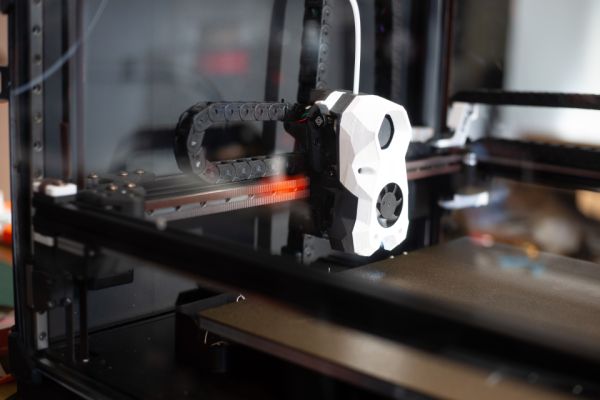
A hardened-steel nozzle running standard PLA, PETG, or ABS can go a long time without a second thought — community reports commonly put hardened steel at low thousands of hours of normal, non-abrasive use before wear becomes a real problem. That number is where most people's mental model of "nozzle lifetime" comes from. It falls apart completely the moment carbon-fiber or glass-fiber filled filament enters the picture.
Why filled filaments are a different problem
CF and GF filaments aren't just "a bit tougher on the nozzle" — the embedded fibers are abrasive particles that continuously scrape the orifice every time filament passes through it, the same way sandpaper works. Standard filaments don't do this; filled filaments do it on every single print, without exception.
The practical result: the orifice gradually enlarges. A worn nozzle prints wider lines than the slicer thinks it's printing, layer adhesion and dimensional accuracy degrade, and eventually the nozzle isn't usable for precision work at all.
How fast, really
This is the part that surprises people who are used to standard-filament lifetimes:
- Some community reports describe measurable orifice wear/enlargement on a hardened-steel nozzle after as little as around 10 hours of printing an abrasive filled filament — a couple of jobs, not a couple of months.
- In extreme cases, with the most heavily filled or otherwise abrasive materials, a nozzle can be visibly damaged within a single print.
- Brass nozzles — common as the stock nozzle on many non-Bambu printers — wear even faster than hardened steel under abrasive filament, and generally shouldn't be used with CF/GF materials at all. Brass is soft; it wasn't designed for this.
What to run instead
- Hardened steel is the practical minimum for regular CF/GF printing — it's what most printers ship with for exactly this reason, and it holds up far better than brass, even if it isn't immune.
- Ruby-tipped and other wear-resistant nozzles cost noticeably more upfront but are worth it if abrasive printing is a regular part of the business, not an occasional one-off job — the upfront premium gets paid back in fewer replacements and more consistent print quality across jobs.
Budgeting it as a cost line
The core mistake is treating nozzle replacement like a standard-filament consumable — something you check on annually and mostly forget about. If CF/GF filament is a regular part of the print mix, that model doesn't hold. Nozzle replacement needs to be budgeted per job or per a handful of jobs, not per year, the same way film and screen wear get their own line items on a resin printer instead of getting folded into "printer maintenance, ignore for now."
A practical way to handle it:
- Track nozzle cost the same way this calculator already tracks other consumable/equipment costs with a defined lifetime — price divided by expected hours (or expected jobs) of abrasive-filament use, added as its own line rather than absorbed into general printer depreciation.
- If a customer's job specifically requires CF/GF material, that job's quote should carry a proportional share of the nozzle wear it's causing — it's not fair (or sustainable) to let a filled-filament job quietly eat into the margin of the next several standard-filament jobs that happen to use the same printer.
- Keep a spare nozzle (or several) on hand if abrasive printing is routine — an unplanned mid-job nozzle failure costs more in downtime than the part itself.
Calculate your price in a minute
Free calculator: part weight, print time, material price — no sign-up needed.
 App Store
 Google Play
 RuStore
If abrasive printing is a real part of your service offering, it's also worth factoring nozzle durability into which printer you're running it on in the first place — some machines make hot-swapping a hardened or ruby nozzle far less friction than others.
Bottom line
Abrasive filled filaments turn nozzle replacement from an annual afterthought into a near-per-job consumable cost — sometimes as fast as ~10 hours of printing before wear shows up, occasionally in a single print. Skip brass entirely for CF/GF work, budget hardened steel as the baseline, and treat a ruby-tipped nozzle's upfront cost as worthwhile if abrasive filament is a regular part of the business. Whatever nozzle you choose, cost its wear as its own line item tied to abrasive-print hours — not folded into general printer depreciation, where it will quietly underprice every filled-filament job you take.