
October 7, 2026
How Much Filament Is Left on a Spool: Calculator by Weight
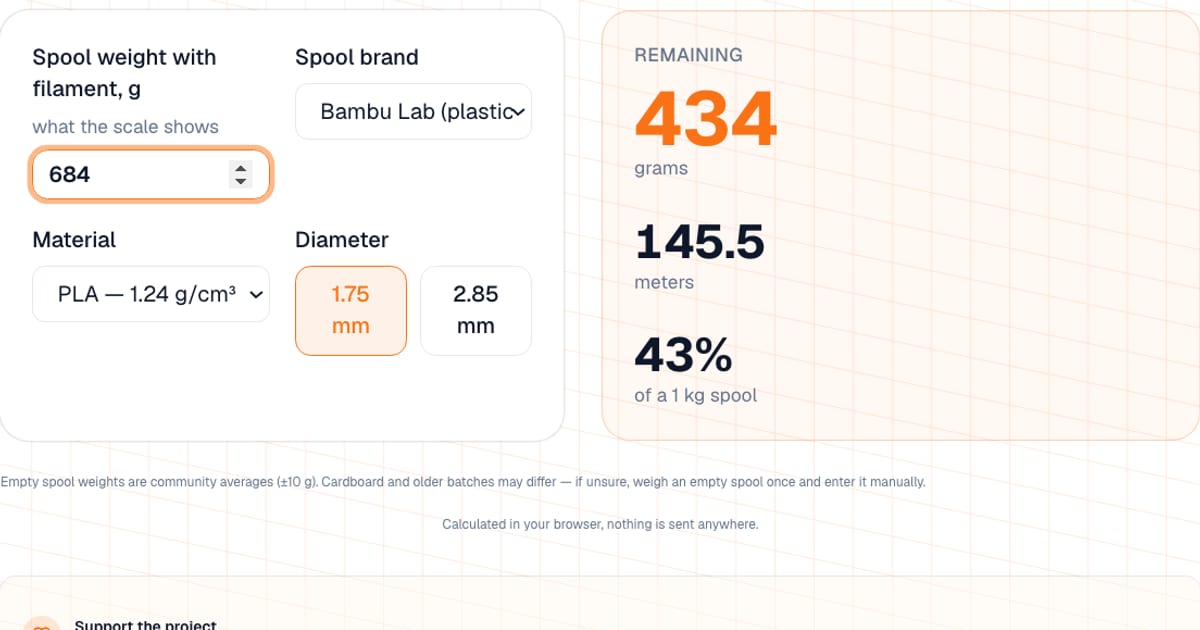
To find out how much filament is left on a spool, weigh the full spool and subtract the weight of the empty one. The difference is the filament left, in grams. I built a free filament remaining calculator that does the subtraction for you and shows grams, meters and the percentage of a 1 kg spool. It runs in your browser with no sign-in, empty spool weights for popular brands are prefilled, and nothing you type is sent anywhere.
How do I calculate remaining filament by weight?
- Take the spool off the holder and put it on a kitchen scale. For a standard 1 kg spool, a scale with 1 g resolution and a 2 kg limit is enough.
- Enter the reading in the field “Spool weight with filament, g”.
- Pick the spool brand. If yours is not listed, choose “Other” and type the empty spool weight.
- Pick the material (PLA, PETG, ABS, ASA, TPU, Nylon or PC) and the filament diameter, 1.75 or 2.85 mm.
- Read the result: grams left, meters left and the percentage of a 1 kg spool.
Example: the scale shows 1180 g, the spool is the reusable plastic Bambu Lab one (250 g), the material is PLA at 1.75 mm. Filament left: 1180 − 250 = 930 g, about 312 m, or 93%. Another one: 740 g on the scale, an eSun spool (224 g), PETG at 1.75 mm. That leaves 516 g, about 169 m, or 52%.
Meters are calculated by dividing the mass by the material density to get volume, then dividing the volume by the cross-section area of the filament. For 1.75 mm PLA that works out to about 3 g per meter.
How much does an empty spool weigh?
The calculator uses averaged community values, not official manufacturer data:
| Brand | Empty spool weight |
|---|---|
| Bambu Lab, reusable plastic | 250 g |
| eSun, plastic | 224 g |
| Prusament | 200 g |
| Creality | 190 g |
| Bambu Lab, cardboard | 145 g |
| Overture, cardboard | 140 g |
| Polymaker, cardboard | 140 g |
| SUNLU | 135 g |
| ELEGOO | 130 g |
| Anycubic | 120 g |
The error is around 10 g, and cardboard spools and older batches can vary more. The most reliable approach: when a spool runs out, weigh the empty one, write the number on the side with a marker, and enter it manually next time.
How many meters are in a kilogram of filament?
Values below are calculated from the densities the calculator uses:
| Material | Density, g/cm³ | 1 kg at 1.75 mm | 1 kg at 2.85 mm |
|---|---|---|---|
| PLA | 1.24 | 335 m (1,099 ft) | 126 m |
| PETG | 1.27 | 327 m (1,073 ft) | 123 m |
| ABS | 1.04 | 400 m (1,312 ft) | 151 m |
| ASA | 1.07 | 389 m (1,276 ft) | 146 m |
| TPU | 1.21 | 344 m (1,129 ft) | 130 m |
| Nylon (PA) | 1.14 | 365 m (1,198 ft) | 138 m |
| PC | 1.20 | 346 m (1,135 ft) | 131 m |
The real filament diameter and the density of a specific brand differ slightly, especially for filled filaments such as wood or carbon fiber blends. That is accurate enough to judge whether there is enough, but if you keep books, use grams.
Is what is left enough for a print?
Slice the model first. Bambu Studio, OrcaSlicer, PrusaSlicer and Cura all show filament usage in grams and meters. If you already have a G-code file, the G-code analyzer shows usage too. Compare that number with what is left on the spool.
I do not print right to the limit. I keep about a 10% reserve for the skirt, supports and a failed start. On multicolor prints with an AMS the reserve needs to be larger, because some filament goes into the purge at every color change (more in the post on purge waste and how to price it). If the spool is borderline for a long print, a fresh spool costs less than a part that fails in the last layers.
What mistakes skew the result?
- Forgetting the spool weight. The scale shows the spool together with the filament, and an empty spool weighs 120 to 250 g. Without subtracting it, the leftover is overstated by that amount.
- Picking the wrong material. If you leave PLA density selected for PETG, the meters come out about 2.4% too high. The grams do not depend on the material, only the meters do.
- Mixing up the diameter. For 2.85 mm there are about 2.65 times fewer meters than for 1.75 mm at the same weight.
- Weighing extra things. An adapter, a desiccant pouch or a piece of filament hanging off the spool adds weight. Weigh the spool the same way you weighed it empty.
- Expecting a percentage for a non-standard spool. The percentage is relative to a 1 kg spool. For 500 g or 2 kg spools, read the grams and meters.
How is this different from Spoolman and other tracking methods?
The calculator answers one question: how much is left right now. It does not remember anything and does not track consumption. There is no spool database, so it suits a one-off check, not bookkeeping.
- A scale and the calculator fit when you have a few spools and want a quick check before a print. Nothing to install.
- Spoolman is for when you want tracking to happen on its own: it stores your spools and deducts filament as you print. You need to run a server and connect it to the printer. I wrote up the Klipper setup in the Spoolman with Klipper and Moonraker guide, and the options that do not need your own server are in the Spoolman alternatives roundup.
- A workshop stock system is for when money matters as well as weight: purchase batches, price per kilogram, deductions per order and cost price. How that differs from tracking the remainder is covered in Spoolman versus filament tracking in 3D Print Pricing.
If you are checking spools because of storage, see when a filament dryer pays for itself: filament that has been sitting open for a long time is best used first.
What next?
Now that you know what is left, you can price the print: the cost calculator takes the spool price, the part weight and the print time. A reference of densities and print temperatures for each plastic is on the materials page.
Calculate your price in a minute
Free calculator: part weight, print time, material price — no sign-up needed.
 App Store
 Google Play
 RuStore
Frequently asked questions
- How do I know how much filament is left on a spool?
- Weigh the whole spool and subtract the weight of an empty one. The result is the filament left in grams, and the length follows from the material density and the filament diameter. The free calculator on this site does both and also shows the percentage of a 1 kg spool.
- How much does an empty filament spool weigh?
- For popular brands it is between 120 and 250 g: about 120 g for Anycubic, 130 g for ELEGOO, around 140 g for cardboard Polymaker and Overture spools, and about 250 g for the reusable plastic Bambu Lab spool. These are community averages within roughly 10 g, so weigh your own empty spool once.
- How many meters of filament are in a 1 kg spool?
- At 1.75 mm that is about 335 m of PLA, 327 m of PETG, 400 m of ABS and 389 m of ASA. At 2.85 mm there is about 2.65 times less length, roughly 126 m of PLA. The numbers come from material density and nominal diameter, so real spools differ slightly.
- How can I tell if there is enough filament for a print?
- Slice the model and read the filament usage in grams or meters, then compare it with what is left on the spool. Keep a reserve of about 10% for skirt, supports and a failed start, and more for multicolor prints with an AMS because some filament goes into the purge.
- Can I estimate the remaining filament without a scale?
- Only roughly, from the winding thickness and spool diameter. Spools differ in width and core size, so the same half-full look can mean very different weights. A kitchen scale with 1 g resolution is cheap and far more accurate than a visual guess.
- Do I need Spoolman to track how much filament is left?
- No. Spoolman is a separate self-hosted server that tracks spools automatically and connects to Klipper through Moonraker. For an occasional check, a scale and the calculator are enough and nothing needs to be installed.
- Does the calculator work for spools that are not 1 kg?
- Grams and meters are correct for any spool as long as you enter its empty weight. The percentage is shown relative to a 1 kg spool, so for 500 g or 2 kg spools rely on the grams.